Spotiguess : Music Quiz
- 4.4
- Rating
- 50.00K
- Installs
- Free
- Price

 Analysis by App-foxy
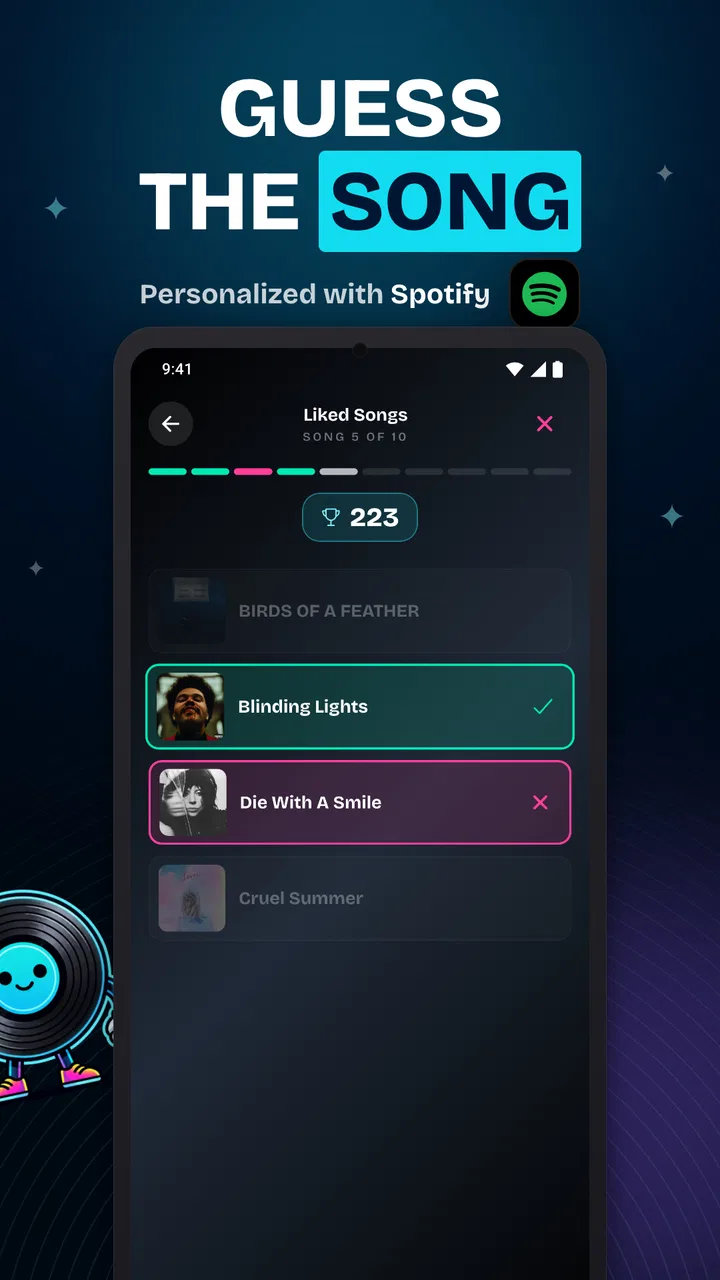
I enjoy music quiz games most when they make a short break feel active without demanding a long tutorial. Spotiguess: Music Quiz takes that simple idea and turns it into a quick guessing challenge built around identifying songs. I found the appeal easy to understand: you listen, think, and try to recognize the track before your confidence disappears. It is not trying to replace a music streaming service or become a full rhythm game. Its purpose is narrower, and that focus is part of why it can work so well in the right situation.
Developed by RicoCorp, this free music game is aimed at anyone who likes testing their memory against familiar songs. It is rated for Everyone, so it is a comfortable choice for casual play with family or friends. The current version is 1.4.2, and the game requires Android 7.0 or later. On the store, it has an average rating of 4.4 from around 500 ratings, with more than 50 thousand installs. Those figures suggest a healthy audience for a relatively focused title, although the small number of written reviews means the rating should be treated as a useful signal rather than a complete picture.
How Spotiguess feels during a normal session
The first thing I noticed is that the game is easiest to enjoy in short sessions. A few rounds fit naturally into a coffee break, a commute, or the quiet minutes before an appointment. The basic challenge does not need much explanation, which matters for a music quiz: the fun should come from recognition, not from learning complicated controls.
You May Also Like

 AccuWeather: Weather Radar
AccuWeather Review: A Quick, Clear Forecast for Everyday Decisions
For everyday plans, the best forecast is the one you can understand quickly. AccuWeather makes rain timing, radar, and local conditions easy to act on, with a few trade-offs.

 Hill Climb Racing
Why Hill Climb Racing Still Turns Crashes Into One More Run
A tiny car, a bumpy hill and one more upgrade: Hill Climb Racing keeps resurfacing because its simple chaos makes every near-miss feel personal.

 AliExpress - Shopping App
AliExpress Makes Global Shopping Feel Personal, but Shoppers Bear the Risk
AliExpress turns a global marketplace into a pocket-sized discovery engine. Its reach is useful, its shopping loop compelling, and its trade-offs easy to miss.

 Lords Mobile: Kingdom Wars
Lords Mobile Is a Kingdom-Building Routine, Not a Quick Match
A case-by-case verdict on the building, battles, device demands, and social commitments that make Lords Mobile rewarding for some players and exhausting for others.

 PDF Scanner app - TapScanner
TapScanner Makes Paperwork Easier to Capture, Check, and Share
TapScanner makes scanning with a phone feel less like a rescue operation and more like a dependable step in getting work done. Its capture tools are useful, though not flawless.

 Block Blast!
 Shows How Much a Puzzle Game Can Leave Out
A quiet grid game shows why puzzle players increasingly value instant clarity, repeatable skill and low-pressure play—and where the genre still needs to catch up.
More From Our News Desk
View All News


Its strongest use case is social. I can imagine opening it while sitting with friends and passing the phone around, especially when everyone has different musical strengths. One person may recognize an artist immediately, while another remembers a chorus but not the title. That creates a useful kind of disagreement: the game gives the group a reason to compare memories rather than simply play alone.
Solo play has a different character. Without other people reacting to each answer, the experience depends more heavily on whether the selected songs match your taste and memory. If you regularly listen to a broad range of music, the guessing format can remain engaging. If your listening habits are narrow, some rounds may feel less like a test of knowledge and more like a matter of luck.
Speed expectations and the value of quick rounds
For a game like this, perceived speed is not only about how quickly a screen opens. It is also about how quickly I can move from one guess to the next. Spotiguess benefits from a straightforward concept because there is little reason to pause for menus, character upgrades, or a long explanation. That makes it suitable for brief bursts rather than an evening that requires a large commitment.
I would still approach it with the expectations of a music quiz, not a competitive action game. The important response is whether the audio and answer flow feel clear enough for me to concentrate on recognition. Any delay around a song prompt can affect the fairness of a round, because a quiz depends on timing and attention. For that reason, I prefer playing when the phone is not already struggling with several demanding tasks.
A practical tip is to begin with a few relaxed rounds instead of treating the first session as a serious score attempt. This lets you learn the rhythm of the game and notice whether your device handles the transition between questions smoothly. It also prevents a common mistake: blaming your music memory when the real problem is distraction, low volume, or a busy phone.
What happens when the game gets heavy use
Music games can become more demanding in real life than they appear on a store page. A single round may be light, but repeated play involves continuous audio, frequent touches, and repeated screen changes. I would be especially mindful of this during a long group session, when the phone may already be warm, connected to other accessories, or running several apps in the background.
Spotiguess is best treated as a focused activity. Before a longer session, closing unused apps and checking that the device has enough charge is sensible. This is not because the game is known to be unusually resource-heavy; it is because audio-based play is more enjoyable when the phone is not competing for attention or system resources. Keeping the volume at a comfortable level also helps, since guessing becomes tiring when every round requires straining to hear.
There is a trade-off between convenience and concentration. Playing with headphones can make the song easier to identify and reduce background noise, but it makes the game less social. Using the phone speaker allows everyone to participate, though the room can affect how clearly the music comes through. In a small quiet room, the speaker may be enough. In a noisy setting, headphones or a closer group position will usually produce a fairer experience.
Another useful habit is to pause between sessions rather than leaving the game open indefinitely. Short breaks keep the quiz feeling fresh and give the device a chance to cool if it has been handling audio continuously. This also helps with social play: people tend to discuss the last answer, compare guesses, and return with more enthusiasm than they would if rounds were rushed together.
Reliability, recovery, and the frustrating moments
Reliability matters more in a guessing game than many players expect. If an answer is lost, a round is interrupted, or the app needs to be reopened, the effect is not merely cosmetic. The interruption can remove the exact moment of recognition that made the question enjoyable. I therefore judge this type of app by how easily I can get back into the activity after a distraction or a temporary problem.
My advice is to treat each round as a self-contained attempt. If you receive a call, switch to another app, or need to hand the phone to someone else, do not assume that an unfinished question will remain exactly where you left it. Finishing a round before changing tasks is the safer workflow. It also makes group play easier because everyone knows when a turn has ended.
Recovery is particularly important on older Android devices. The minimum operating system is Android 7.0 or later, but operating-system compatibility alone does not tell me how much free storage, memory, or battery health a particular phone has. A device that meets the software requirement may still feel less comfortable if it is already overloaded. Keeping the system updated where possible and restarting a phone that has become sluggish are ordinary steps, but they can make a noticeable difference to any audio game.
I also recommend avoiding aggressive battery-saving settings during a serious session if they interfere with audio or background activity. Battery management varies by phone manufacturer, so the exact behavior can differ. The sensible approach is not to change every setting blindly, but to notice whether the device pauses audio or becomes slow after the screen has been idle. If that happens, a short, active session is likely to be more reliable than leaving the game untouched for a long time.
Device limits and who should think twice
Spotiguess has a broad age rating and a modest minimum Android requirement, which makes it approachable for many users. Still, “works on the operating system” and “feels comfortable on every phone” are not the same thing. Older hardware may have weaker speakers, slower app switching, or less dependable multitasking. Those limitations can affect a music quiz because the quality of the listening experience is central to the result.
I would be cautious about recommending it as the main entertainment choice for someone who needs accessibility options tailored to a specific hearing or vision requirement. A general Everyone rating does not automatically mean that every player will find the audio and text presentation equally comfortable. Anyone relying on captions, very large text, or other specialized controls should test the experience personally before committing to longer sessions.
It is also worth considering the environment. This is not the ideal game for a crowded bus if you cannot hear the music, nor is it the best choice when you need to keep your phone silent. At home, with a reasonable volume and a few minutes of attention, the format makes much more sense. The game rewards listening, so interruptions are more damaging than they would be in a turn-based puzzle that can be examined at any pace.
The free entry point is helpful, especially for people who want to try the concept before spending anything. However, in-app purchases range from $5.99 to $34.99 per item. That creates an important decision point: I would play the free experience long enough to decide whether the song-guessing format genuinely fits my habits before considering any purchase. A paid item should feel like an optional enhancement to a game I already enjoy, not a way to rescue a format that does not match my taste.
How it compares with ordinary music alternatives
A music streaming app is better when I want control over what I hear, uninterrupted listening, playlists, or discovery. Spotiguess is better when I want the music to challenge me. That distinction sounds small, but it changes the entire purpose of the session. Streaming asks me to choose songs; this game asks me to remember them.
It also differs from a traditional trivia app. General trivia can test facts about history, science, or entertainment, while this title concentrates the challenge around musical recognition. That makes it more personal: my result depends on what I have heard, what I remember, and how quickly I connect a sound with a name. Someone who enjoys broad knowledge quizzes but rarely remembers artists may prefer a different category.
Compared with a rhythm game, the appeal is less about precise tapping and more about listening memory. Players who want fast reflexes, visual effects, or a strong progression system may find a rhythm-focused alternative more satisfying. I would choose Spotiguess for conversation, recognition, and quick mental competition, not for deep customization or a long-form campaign.
One non-obvious advantage is that the game can reveal how differently people remember music. A friend may identify a track from its opening while another recognizes only the vocal style. That makes it useful for informal gatherings where the goal is not simply to achieve a personal best. The limitation is equally clear: the experience depends on the relevance of the songs to the players, so a mixed group may need patience when one person knows far more than everyone else.
Small strategies that make the quiz more enjoyable
I found that it helps to separate confidence from certainty. In a group, players often shout the first answer that comes to mind, then influence everyone else. A better approach is to let each person form an answer privately before discussing it. This keeps the round from becoming a contest of who speaks loudest and gives quieter players a fair chance.
Another useful strategy is to listen for structure rather than waiting for a familiar lyric. The opening rhythm, vocal texture, or repeated musical pattern can trigger recognition before the obvious part arrives. This makes the game more interesting for experienced players, because it turns each round into an exercise in attentive listening rather than a simple memory search.
For family play, I would avoid making every round about winning. Let younger players explain what they hear, even when the answer is wrong, and use the result as a conversation starter. The Everyone rating supports that relaxed approach, but the game still works best when adults do not turn a casual quiz into an intimidating examination.
For solo sessions, keeping attempts short is a better test of memory than grinding for a long time. Repeatedly replaying a question can make the answer feel familiar even when it was not recognized naturally. If I want an honest sense of my ability, I would stop after a compact session and return later rather than immediately repeating the same challenge until it becomes predictable.
My performance verdict
Spotiguess: Music Quiz is a focused, free music game with a clear reason to exist. I like it most as a quick social activity or a lightweight solo test, especially when I want something more interactive than simply pressing play on a playlist. Its strengths come from the direct guessing format, the accessible age rating, and the low barrier created by its Android compatibility from version 7.0 onward.
The main limitations are tied to the same simplicity that makes it approachable. Players looking for a deep rhythm system, extensive progression, or full control over their listening experience should choose a different kind of app. The quality of a session also depends heavily on the room, the phone’s speaker or headphones, the player’s musical background, and how smoothly the device handles audio while multitasking.
I would recommend trying the free version during a quiet break or with a small group before thinking about the optional purchases. Keep the phone reasonably clear of background tasks, use headphones when the environment is noisy, and treat each round as a short listening challenge rather than an endurance test. With those expectations, RicoCorp’s game is an enjoyable way to turn familiar music into a friendly competition.
My final view is positive but specific: choose Spotiguess when you want to test musical memory, not when you want a complete music service or a demanding arcade game. For the right listener, that narrow purpose is enough to make it worth keeping around for spontaneous quizzes, relaxed gatherings, and those spare moments when recognizing a song feels more satisfying than merely hearing it.
FAQs for Spotiguess : Music Quiz
01What is Spotiguess: Music Quiz?
Spotiguess: Music Quiz is a music-trivia game that challenges you to identify songs, artists, or musical details from short audio clues. It is designed for casual play, with quick rounds that test how well you know popular music. The app can be entertaining for solo players and music fans who enjoy guessing games, competitive scores, and discovering how broad their musical knowledge really is.
02How does the gameplay in Spotiguess work?
After starting a quiz, you listen to a brief music sample and choose the correct answer from the options provided. The faster and more accurately you respond, the better your result is likely to be. The game may include different categories, artists, genres, or themed challenges, so the experience can vary between rounds. It is simple to understand, but difficult questions can still provide a real challenge.
03Does Spotiguess: Music Quiz require an internet connection?
An internet connection may be required for some or all features, particularly when the app loads music clips, updates quiz content, synchronizes scores, or connects to online rankings. Availability can depend on the version installed and the device platform. Before downloading, users should check the app-store description and permissions, especially if they want to play while traveling or using limited mobile data.
04Is Spotiguess free to download and play?
Spotiguess: Music Quiz may be available as a free download, but free access does not always mean that every feature is included without restrictions. The app may contain advertising, optional purchases, premium content, or limits on certain quizzes and attempts. It is worth reviewing the current store listing before installing so you understand whether payments are optional and whether any trial or subscription terms apply.
05Is Spotiguess suitable for children and all music listeners?
The game can be suitable for casual players and families, but its appropriateness depends on the music, artwork, advertisements, and online features included in the current version. Some questions may focus on contemporary songs or artists that are not intended for younger audiences. Parents should review the store age rating, privacy information, and in-app purchase settings before allowing children to download or play.
Pros
- Quick rounds make it easy to play during short breaks.
- Covers many music styles
- so playlists rarely feel repetitive.
- Guessing songs from brief clips keeps the gameplay engaging.
- Simple controls make it accessible for casual players.
- A good choice for testing your music knowledge alone or with friends.
Cons
- Some questions may favor listeners familiar with mainstream hits.
- Repeated tracks can make longer sessions feel less varied.
- Audio recognition may be harder with noisy surroundings or weak speakers.
- Progression can feel limited if you prefer deeper quiz customization.
- Players may need an internet connection for consistent access to content.

Spotiguess : Music Quiz
Gallery